Showing posts with label Rotary International. Show all posts

Thursday, 27 September 2012

Group Study Exchange Visit from Nepal


The Rotary Foundation’s Group Study Exchange (GSE) program is a unique cultural and vocational exchange opportunity for businesspeople and professionals between the ages of 25 and 40 who are in the early stages of their careers. The program provides travel grants for teams to exchange visits in paired areas of different countries. For four to six weeks, team members experience the host country's culture and institutions, observe how their vocations are practiced abroad, develop personal and professional relationships, and exchange ideas.

In a typical four-week tour, applicants participate in five full days of vocational visits, 15 to 20 club presentations, 10 to 15 formal visits and social events, two to three days at the district conference, three to four hours per day of cultural and site tours, and three to four hours per day of free time with host families.

For each team member, the Foundation provides the most economical round-trip airline ticket between the home and host countries. Rotarians in the host area provide for meals, lodging, and group travel within their district.

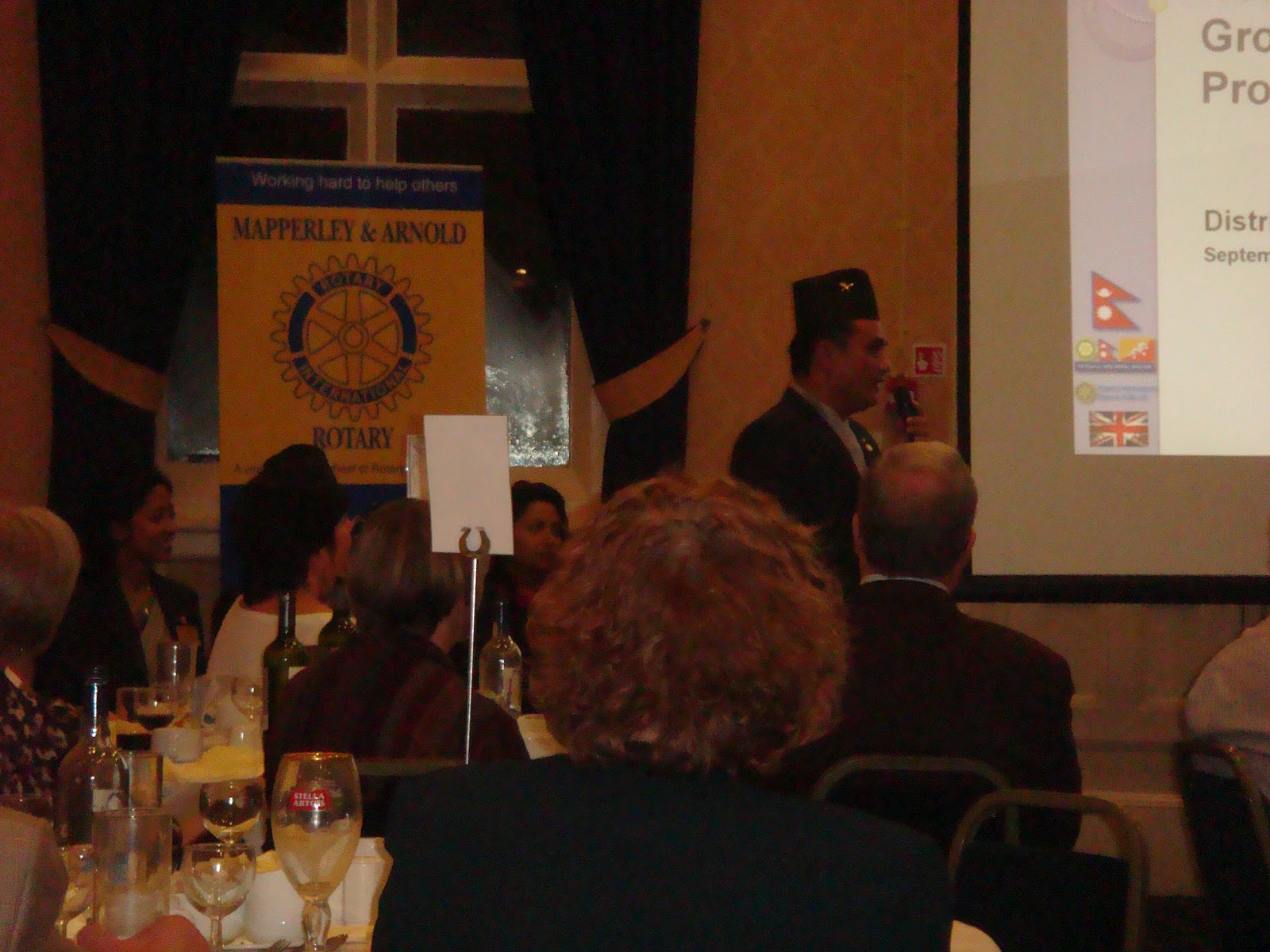
Our Rotary district currently have a GSE team visiting from Nepal District 3292 under the leadership of Rotarian Nugal Vaidya.  Their first formal presentation was at the weekly meeting of the Mapperley & Arnold Rotary Club.  The host club had also invited other guests along including Sue Leyden of the Himalayan Trust UK.  Sue is the second daughter of Lord Hunt was was the leader of the successful 1953 British Expedition to Mount Everest.. The Mapperley & Arnold Club had supported the Himalayan Trust and Sue spoke about ongoing work to rebuild schools that had been devastated in recent earthquakes in Nepal.


Each member of the Nepal GSE team were introduced and spoke a little about themselves, their background, vocation and then shared different aspects of Nepal’s culture.

Wednesday, 19 September 2012

The Four Way Test


One of the internet Rotary forums I belong to asked the question, “How does your club close your weekly meeting.”  Until I read some of the posts, I never realised that there were different ways of doing it.  I assumed that the way my club closes was the standard approach right across the organisation.

Hucknall close with all Rotarians and guests standing and saying the International Toast which is “Rotary and Peace the World over.”  Many clubs finish their meetings with this  toast. The members don’t think twice about it – but they should. It isn’t an idle wish, but a vision that our organisation really can make happen.

In 1940 the world was at war. Paul Harris, founder of Rotary wrote in The Rotarian magazine that February: ‘Must the best genius of men be devoted to the science of war and none to the science of averting it?’

The Second World War began to clarify views within our organisation that we could and should strive to make our world a far more peaceful place. After the war, The United Nations were formed. Around 100 Rotarians were deeply and fundamentally involved at senior levels in the formation of the most famous of all Organisations for Peace. Many people, even Rotarians don’t realise that Rotary has such an incredible history of ground breaking work in this field.

Some clubs close with their national anthems, others closed with the recitation of Rotary’s Four Way Test which was devised by  a U.S. Rotarian.  The statement and the principles it embodied also helped many others find their own ethical compass. Soon embraced and popularized by Rotary International, The Four-Way Test today stands as one of the organization’s hallmarks. It may very well be one of the most famous statements of our century.

Herbert J. Taylor, author of the Test, was a mover, a doer, a consummate salesman and a leader of men. He was a man of action, faith and high moral principle.

During the American Depression he was tasked with rescuing an ailing company.  As he thought about an ethical guideline for the company, he first wrote a statement of about 100 words but decided that it was too long. He continued to work, reducing it to seven points. In fact, The Four-Way Test was once a Seven-Way Test. It was still too long, and he finally reduced it to the four searching questions that comprise the Test today.

Next, he checked the statement with his four department heads: a Roman Catholic, a Christian Scientist, an Orthodox Jew and a Presbyterian. They all agreed that the Test’s principles not only coincided with their religious beliefs, but also provided an exemplary guide for personal and business life.


And so, “The Four-Way Test of the things we think, say or do” was born:

1. Is it the TRUTH?
2. Is it FAIR to all Concerned?
3. Will it build GOODWILL and BETTER FRIENDSHIPS?
4. Will it be BENEFICIAL to all concerned?

In 1942, Richard Vernor of Chicago, then a director of Rotary International, suggested that Rotary adopt the Test. The R.I. Board approved his proposal in January 1943 and made The Four-Way Test a component of the Vocational Service programme.  Herb Taylor transferred the copyright to Rotary International when he served as R.I. president in 1954-55, during the organization’s golden anniversary.

Eloquently simple, stunning in its power, undeniable in its results, The Four-Way Test offers a fresh and positive vision in the midst of a world full of tension, confusion and uncertainty.

Although as a club we are aware of the Four Way Test, it can be easy to take it for granted.  Last night was the monthly Business meeting of Hucknall Rotary Club, and prior to us closing with the International Toast, we recited together the Four Way Test.  This is something that I hope we now practice at all our business meetings.


Saturday, 1 September 2012

Social Highlight


The social highlight of each year for most Rotary Clubs is usually their Charter Anniversary Dinner. This celebrates the Rotary Club receiving its 'Charter' and being formally recognised as a Club by Rotary International.  Yesterday I met with Peter Pickering, Neil South and Colin Worthington to plan the formalities of the Charter Dinner Anniversary being held in my year of office.

Preparations really began a couple of years ago when I read a fantastic book entitled ‘Can We Have Our Ball Back, Please?’ (which was later voted ‘Sunday Times Sports Book of the Year’)


This is Google’s review of said book:

CAN WE HAVE OUR BALL BACK, PLEASE? is the highly entertaining story of how the British invented sport as we know it today (and then almost forgot how to play it). Long before Drake refused to interrupt his game of bowls when the Armada was sighted, the British have had a passionate relationship with games. Here Julian Norridge explores how those games became major sports like boxing, cricket, horse racing and hockey. Their stories cover the whole of Britain - from Welsh-born inventor and tobacco enthusiast Major Walter Clopton Wingfield coming up with a game involving new-fangled rubber balls (lawn tennis), to an apocryphal English football match using severed Viking head as a ball, to Scottish shepherds inventing golf more than 700 years ago. But this is far more than a book about sport, it also takes a very funny, very British look at our popular history and mythology. Full of tales of hunting parsons, prize-fighting ex-slaves, corrupt princes and cuckolded husbands, this is sporting life in all its eccentricity. It chronicles the constant battle between fair play and gambling; between amateurism and professionalism; and between advances in the dame and plain cheating (such as turning up with a cricket bat wider than the wicket). Can We Have Our Balls Back Please? proves that there is an awful lot to be proud of in our history, it suggest where our strange feeling of superiority really comes from and it shows why we are always disappointed when we lost, but rarely surprised.


Coincidently just after I read this book the author, Julian Norridge, placed an advert in the Rotary Magazine offering his services as an after-dinner speaker.  I saw this as an inspiration opportunity and made contact with Julian, inviting him to be the guest speaker at our Charter Dinner being held on Friday 19th October 2012 at the Hostess Restaurant, Sookholme.
 

I’m really looking forward to what will be our 86th Charter Anniversary Dinner and have also enjoyed finding a report listed below of Hucknall Rotary Club receiving its Charter

 
From Hucknall Dispatch – Thursday September 16, 1926

A MEMORABLE EVENT – Charter Presented to the Hucknall Rotary Club

Wednesday evening, September 15, 1926 marked another epoch in the history of Hucknall, for on that day the Rotary Club of Hucknall (which was instituted on March 2 of this year) received its charter in the presence of a large company of Rotarians from various parts of No. 7 District, which stretches from Bedford to Lincoln.

The event, which was  preceded by a banquet, took place in the Public Hall, which up to mid-day was in a state of chaos, the electricians then putting the finishes touches to the electric installation.  With a staff of helpers, tables were erected, cloths spread, the room decorated and all preparations made for the event .  The repost was admirably served by Mrs Warner, and a pretty touch was given to the scene by the appropriate floral decoration to Mr W Williamson  - blue and gold the club’s colour, being appropriately arranged on the tables….

At Hucknall there are at present 26 members, the officers being Mr S. S. Rhodes president, Mr H. Morley vice-president, Mr J H Busfield  treasurer, and Mr W Garland Spencer secretary. 

Needless to say, much preliminary work had to be done prior to the charter night, and it was pleasing to find that there was a gratifying response from the various clubs in the district, about 140 being present.  In addition to the Hucknall officers and members, the company included Rotarian Henry Hyde of Leicester, chairman of the district, Mrs Hyde, Rotarian Sydney James of Ilkeston, vice-chairman, Mrs James, the presidents and secretaries of the various clubs, along with Mr G. A. Spencer, MP for the Broxtowe Division, Mrs Spencer, Mr W. T. Haslam J.P. chairman of the Urban Council, Mrs Haslam and others.

Astonishing Progress

Rotarian Hyde, prior to presenting the charter to President Rhodes, apologised for the absence of the district secretary, Rotarian G K Russell, owing to the illness of his mother.  He regretted that they found themselves still confronted with an industrial struggle, and that Hucknall was in the midst of that terrible disaster.  He was glad, however, that on that occasion they were linked up with the Imperial Parliament and the local Council.  The Rotary movement always welcomed those whom they thought would be interested, even though at times they might be critics.  The duty he had to perform gave him a great deal of pleasure, because from that night the Hucknall Club became officially connected with the great international Rotary movement, the importance of which he trusted they all realised.  There were now under the government of the Association for Great Britain and Ireland 221 clubs with 12,000 members.  When he mentioned that in 1918 there were only eight clubs in this country, they would realise the rapid development which had taken place.  He wished them to form some idea in their minds as to the underlying influence of that great movement, which had made wonderful expansion during recent years.  In Rotary International there were now 2,400 clubs and 122,000 members operating in 35 countries.

A Club’s Responsibilities.

Addressing the President and officers of the Hucknall Club, Rotarian Hyde said they were vested with a great responsibility.  Being a young movement, they had no tradition but they were making them.  Their club had no history but it would make history from that night.  He beseeched the members to be very careful in making that history.  The corner stones were Service, Business Standards, Fellowship, Peace and Goodwill and he urged them to be careful how they built upon that foundation.  In the prosecution of those ideals , though they barred any discussions on political and religious subjects as such, he did not suggest that they should not be influenced by the spirit of Him Who laid down for them the Golden Rule and Whom they acknowledged to be the Author of peace and concord.  Why had the early members of the Hucknall Club been selected?  Because it was thought they  believed in the six objects of Rotary, that they were destined to lift their vocation to a higher level, and to create a brighter outlook on citizenship.  God knew that there was need of it today.  The primary object of service above self.  It was by fellowship they found out what they were and what the other fellow was.  There was much sham in the world, and they desired to get free from the trammels of suspicion.  He urged the members to assimilate the objects of Rotary, and he then believed a great future was before them.

Rotarian Hyde then handed the framed charter to President S S Rhodes and proposed the toast of the Rotary Club of Hucknall.

 President’s Reply.

Replying President Rhodes first thanked the visitors, and was pleased to see so many ladies present.  The most amazing thing about the gathering was that 12 months ago there was no thought of Rotary in Hucknall, except perhaps in the mind of Rotarian Lymm  of Nottingham  and his co-conspirators, and they certainly felt a debt of gratitude to their Nottingham friends for all the help they had given them, together with the assistance of Vice-chairman James.  As they knew, a good deal of preliminary work was necessary, and he was pleased to inform them that they had consolidated the work.  They had found that Rotary inspired each individual member to do his best in life.  As president, he could say that inspiration had been received by some members to do some community service which would not have been thought of.  They were grateful to Chairman Hyde for his wise words of counsel, and he felt it must be a great honour to be the president of a Rotary  Club, and especially of the Hucknall Rotary Club because of the wonderful co-operation shown by every member.  As in the Boys Brigade, great things from little causes spring.  As regards the Charter, the President assured them that they would do their best to live up to the principles it outlined, and trusted that nothing would occur to necessitate that charter being returned.  In conclusion, he assured them that he appreciated all the help which had been shown him.

Hucknall’s Fame

The next toast on the list was that of “The Visitors and Guests,” proposed by Rotarian H Morley who outlined some of the features of Hucknall and pointed out that that had been a memorable year.  In days gone by Hucknall was regarded a good place to get away from, but now people flocked hither in thousands to view the beauties of Titchfield Park, whilst visitors of all nations called at the historic Church to pay tributes to Lord Byron.  There were few towns which could boast of two royal visits in one year, but the Duke of York and the King and Queen of Greece had already visited Hucknall.  As a town, they were perhaps more progressive than any other, and as a Rotary Club more enthusiastic, as was shown by the fact that since they commenced their apprenticeship in that great movement, there had been no room for any other club at the top of No. 7 District.  Some of their guests – the non-Rotarians – might wonder why another club in Hucknall, but he assured them that Rotary was not intended to supplant Christianity, but to supplement it.  He coupled with the toast the name of Mr G A Spencer, MP and Mrs Spencer, Mr W T  Haslam JP and Mrs Haslam, and the various presidents.

The replies were in nutshell form, seeing that only brief moments were allowed on account of the length of the programme.  Helpful words were uttered by Presidents Corbett (Nottingham); Jephson (Ripley), and vice-chairman James.

M.P. Views

Mr G A Spencer MP replied for the guests, and commended the movement for the high ideals which had been set forth by the District Chairman in handing over the charter.  The Rotary ideal was a worthy ideal to strife for and man only obtained in proportion to his striving.  Men were brought to the front by some ideal – by setting themselves a standard – and in so far as they had set, from that night and henceforth, these noble and great ideals before them, he hoped that individually and collectively they would succeed in attaining them.  He felt certain that if the current of human thought and human activity which had been breathed at that gathering could enter the current of our everyday life and thought the antagonism which existed today between nations or between men or between capital and labour, would be dispelled and the spirit of peace and goodwill would become a permanent part of our lives.

Rotarian A E Kaye humorously proposed the toast of “The Ladies” to which Mrs S S Rhodes responded.

During the evening songs were rendered by Mrs A E Kaye, Mrs W H Allcock and Rotarian H Dobson.  Rotarian F W Gray of Nottingham who accompanied, led the community singing, which was a pleasing feature of the  programme, which was carried through without a hitch at the call of Rotarian J W Sampson, toastmaster.

Sunday, 5 August 2012

Standing Crane

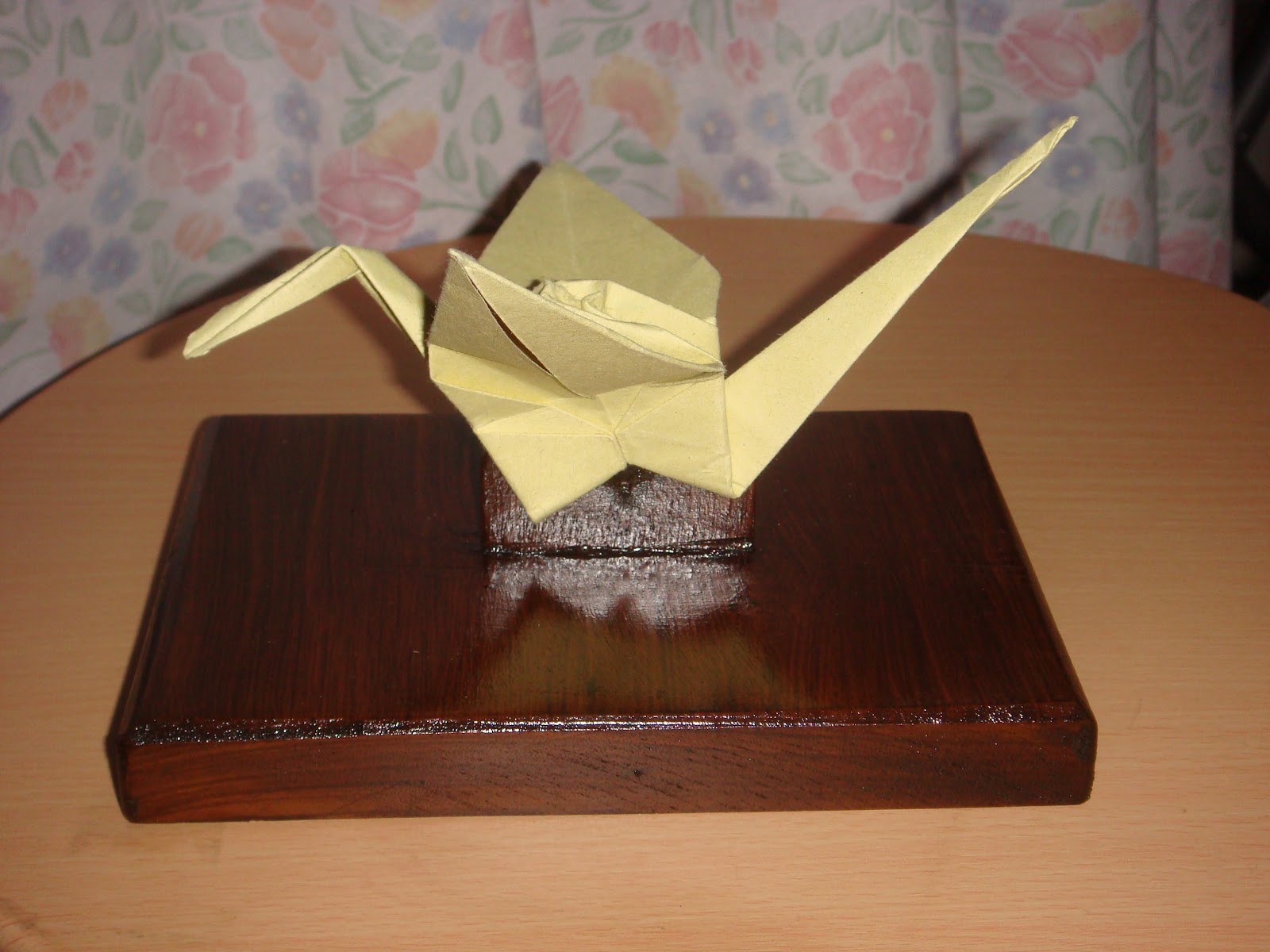
When DG Dave Ashley visited our Club recently,  he presented me with a Japanese Origami Crane which symbolised Rotary's International theme "Peace through service, " and issued me with the challenge to have it on display at every Rotary Club meeting this year serving as a reminder of this year's theme. 

From the shape, you can see that the crane is unable to stand alone, so I'm grateful to PP Neil Sharman who has made a stand for me to rest the origami crane on each week.


The Japanese Origani Crane on its stand


Sunday, 22 July 2012

End Polio Now


Rotary Clubs initiate and support many local, national and international projects.  The majority of these are generally driven by local Rotarians.    A huge emphasis of Rotarians worldwide has been the End Polio Now campaign.
Since 1988, Rotary International and its partners in the Global Polio Eradication Initiative (GPEI) — the World Health Organization, UNICEF, and the U.S. Centers for Disease Control and Prevention — have worked to wipe polio from the face of the earth.
Rotary’s main responsibilities are fundraising, advocacy, and volunteer recruitment. To date, Rotary has contributed more than US$900 million to the polio eradication effort.
With over 33,000 clubs in more than 200 countries and geographical areas, Rotary is able to reach out to national governments worldwide to generate crucial financial and technical support for polio eradication. Since 1995, the advocacy efforts of Rotary and its partners have helped raise more than $8 billion from donor governments.
Rotary clubs also provide “sweat equity” on the ground in polio-affected communities, which helps ensure that leaders at all levels remain focused on the eradication goal. Rotary club members have volunteered their time and personal resources to reach more than two billion children in 122 countries with the oral polio vaccine.
Thanks to Rotary and its partners, the world has seen polio cases plummet by more than 99 percent, preventing five million instances of child paralysis and 250,000 deaths. When Rotary began its eradication work, polio infected more than 350,000 children annually. In 2009, fewer than 1,700 cases were reported worldwide.
But the polio cases represented by that final 1 percent are the most difficult and expensive to prevent. Challenges include geographic isolation, worker fatigue, armed conflict, and cultural barriers.
That’s why it’s so important to generate the funding needed to End Polio Now. To fail is to invite a polio resurgence that would condemn millions of children to lifelong paralysis in the years ahead.
The bottom line is this: As long as polio threatens even one child anywhere in the world, all children — wherever they live — remain at risk.

Overview

Polio eradication is within our grasp. But if we don’t eradicate the disease now, the risk of crippling and deadly polio outbreaks will continue to threaten the world’s children. You can help Rotary get the job done by contributing to Rotary’s PolioPlus program or creating awareness of polio.
Challenges to polio eradication
Health experts agree that these primary challenges must be overcome in order to reach the goal of polio eradication:
  • Halting the spread of the poliovirus in the three remaining endemic countries (Afghanistan, Nigeria, and Pakistan), which continue to export it to polio-free areas
  • Curbing the intense spread of the poliovirus in northern Nigeria and Pakistan
  • Rapidly stopping polio outbreaks in previously polio-free countries
  • Addressing low routine-immunization rates and surveillance gaps in polio-free areas
  • Maintaining funding and political commitment to implement the eradication strategies

Four key strategies for stopping poliovirus transmission
1. Routine immunization
High infant-immunization coverage with four doses of oral polio vaccine (OPV) in the first year of life is critical. Routine immunization is essential because it's the primary way that polio-free countries protect their children from the threat of imported polio. Read more about the bivalent oral polio vaccine.
2. National Immunization Days
For decades, Rotary’s PolioPlus program has been one of the driving forces during National Immunization Days, or NIDs. Rotarians are involved in myriad ways before, during, and after an NID, by providing funds for millions of drops of vaccine, promoting upcoming campaigns in the community, distributing vaccine to local health centers, serving as monitors, working with local officials to reach every child, and participating in surveillance efforts.
3. Surveillance
Rotarians play an important role in working with health workers, pediatricians, and others to find, report, and investigate cases of acute flaccid paralysis in timely manner (ideally within 48 hours of onset). PolioPlus sometimes helps fund containers that preserve the integrity of stool samples during transport to laboratories. The program has also played a leading role in providing equipment for the global poliovirus laboratory.
4. Targeted mop-up campaigns
Rotary’s support of mop-up campaigns is similar to NID volunteering, but on a smaller, often "house-to-house," scale.
Contribute to stopping polio

The biggest obstacles to eradicating polio are the underfunding of the global initiative and insufficient political commitment from the remaining polio-affected countries. Rotary International believes the primary source for additional funds can and should be governments of polio-free industrialized countries. Your contribution through Rotary will help ensure that we keep doing our part to get the job done.


By the time the world is certified polio-free, Rotary’s contributions to the global polio eradication effort will exceed US$1.2 billion. This constitutes nearly 14 percent of all contributions to the global budget through 2010 and represents approximately 66 percent of private sector contributions to the initiative. More recently, Rotary is working with the Bill & Melinda Gates Foundation to help raise much needed funds to eradicate polio.


How funds are spent
In the early stages of the PolioPlus program, Rotary paid for oral vaccines and start-up costs for Rotarian-led social mobilization efforts in polio-endemic countries. Since the 1990s, Rotary has continuously worked with the spearheading partners in the Global Polio Eradication Initiative to determine how funds can best be utilized to meet the needs of the program.
What your contributions do
  • $60 -- 100 children immunized against polio
  • $100 -- 200 posters promoting immunization
  • $250 -- 500 aprons to identify health workers, volunteers, and vaccinators
  • $500 -- 4,000 finger markers to identify children immunized
  • $1,000 -- 700 vaccine carriers
Give through Rotary
Friends of Rotary are welcome to add their support to Rotary’s number-one goal. Contribute today.


Wednesday, 18 July 2012

Rotary's Five Avenues of Service


The fellowship and friendship between Rotarians is a vital part of Rotary.  However, fellowship on its own would make Rotary solely a dining club, not a service organization.  Rotary is structured so that clubs can provide “service above self” and every rotarian has the opportunity to make a difference.

The Object of Rotary is to “encourage and foster the ideal of service as a basis of worthy enterprise.” Rotary is a service organization. Since 1910, the Rotary Motto has been “Service Above Self.”

Rotary strives to achieve its objective of “Service Above Self” through activities in five primary areas. These are often referred to as the Five Avenues of Service.


This “Avenue” promotes the development of acquaintance as an opportunity for service. It involves the activities necessary to make the Club function successfully and achieve its goals.


This area represents the opportunity that each Rotarian has to represent the dignity and utility of one’s vocation as an opportunity to serve society. Rotarians promote and foster high ethical standards in business and professions and promote the recognition of the worthiness of all useful occupations.


This “Avenue” relates to the activities that Rotarians undertake to improve the quality of life in their community. Particular emphasis is given to helping children, needy families, the aged, the handicapped, and those most in need of assistance. Rotarians strive to promote the ideal of service in their personal, business, and community lives.


In this area, Rotarians strive for the advancement of international understanding, goodwill, and peace through a world fellowship of business and professional persons united in the ideal of service. International Service Projects are designed to meet the humanitarian needs of people in many lands, with particular emphasis on the most underprivileged children and families in developing countries.


By nurturing youth, Rotarians can provide the skills young people need to succeed as future community leaders. Youth Programs provide Rotarians the opportunity to develop their own leadership and communication skills and also provides for many incredible moments!


The committees within a club reflect these five avenues of service.  Different clubs will implement these in different ways. 


Hucknall Rotary Club’s Council (known as Board of Directors in some Rotary circles) meets usually on the first Monday of the month.  The recommendations of the council, along with the monthly committee reports, are then presented to the Club Business meeting which usually takes place on the third Tuesday of the month.

The committee reports usually focus on ongoing projects and future plans.  For example, at our club Business meeting last night, the Vocational Committee reported that a recent fund-raising appeal to purchase an Automated External Defibrillator (AED ) for the local leisure centre had been successful.  Our Vocational Committee chairman, who is a First Aid Instructor, is providing training on using the AED to 24 members of staff at the Leisure Centre.

Monday, 16 July 2012

Rotary Showcase


As well as being the wedding day of my niece, Saturday 14th July marked the occasion of the Rotary Showcase taking place in the centre of Nottingham.  The clubs within District 1220 are sub-divided into area groups under an Assistant Governor.  Hucknall, being located seven miles north of Nottingham, falls into the Central Area Grouping.  The Central group have for the last three years organised a Showcase event promoting and highlighting all the positives and elements of Rotary.


Hucknall Rotary Club members managed the health and safety aspects of the day, organised the first aid requirements through our contacts with the St. John’s ambulance organisation and manned the tent promoting Rotary Foundation. 


The mission of The Rotary Foundation is to enable Rotarians to advance world understanding, goodwill, and peace through the improvement of health, the support of education, and the alleviation of poverty.


The Foundation is a not-for-profit corporation supported solely by voluntary contributions from Rotarians and friends of the Foundation who share its vision of a better world.

Family and Rotary


The Rotary Motto “Service above Self” is not just applicable to our Rotary activities, but to all aspects of our lives.  Being a Rotarian helps define who I am and the standards I hold.  Being a Rotarian also means that I don’t neglect other areas of my life in order to serve in Rotary.  In fact, if anything, Rotary should enhance all that I am and all I do. 


Rotary is no longer a male only environment and some spouses themselves are now  also Rotarians.  Some clubs, including mine, are closely affiliated with an Inner Wheel club.  The Rotary Club of Hucknall greatly value the support that Hucknall Inner Wheel Club give us.  Without their input , assistance, support and hard work, our “service about self” would be the poorer.


 The work we do for Rotary is all voluntary and it is important to find the right work/ volunteer –community/ home  balance. 


I’m grateful that, as President, I have the full support of my partner, family, friends and club. I have come to view my fellow Rotarians, not as social acquaintances   working together for community betterment, rather as friends who I can share the joys and disappointments of normal life. 


In the dark times you discover who your true friends are as they stand by you.  In the good moments, your friends rejoice with you.


So I finish this post sharing a happy moment.  The first Rotary function that I missed this year (Rotary Showcase) was one of those moments.  My eldest niece and her fiancĂ©e celebrated their wedding.  It was a joyful day for all the families joining together.  My heartiest congratulations to the happy couple:  Adam & Charlotte Robinson.

Networking


There are so many worthy local community groups all serving their localities on limited resources, often struggling to motivate volunteers and sometimes unaware of other groups who may be able to assist or signpost.  I set out in my presidential address to the club  at our Club Assembly, my intention to network with as many local organizations as possible and help facilitate many projects for the betterment of our town.  These are the causes I’ve managed to become involved with in the first couple weeks of July:


Pride of Hucknall

The Pride of Hucknall awards were inaugurated in 2008 in memory of long-serving Hucknall County Councillor Nellie Smedley.   The prestigious accolades recognizes the accomplishments of Hucknall young people aged between 11 and 17, over the last year.  The Pride of Hucknall presentation ceremony will take place on Saturday 22nd September 2012, at the Central Methodist Church, Baker Street.  The ceremony will include a performance by the Hucknall and Linby Mining Community Brass Band and the presentation of medals to all nominees.

The Big Draw

The Big Draw is the world’s biggest celebration of drawing. It has grown into a month-long festival running throughout October in all parts of the UK. Every year more organisers across the world join the Big Draw family and run drawing events to engage their communities in creative activities. Sure Start, Hucknall are driving the event under the title 'Flying the Flag for Hucknall' and are encouraging the involvement of as many community groups as possible. Vinyl banners are being sought which will be used to make bunting. Local schools are involved and will be making bunting that features self-portraits of all pupils to hang outside their schools. During October school half-term, there will be craft activities at different locations around Hucknall and exhibitions being held at the Library, on the Market Place and in the Gallery in Baker Street.


“Facebook and Funding”

A project, ‘Focus on Funding’ launched by Nottinghamshire CVS ran a seminar entitled “Facebook and Funding.”  The event took place at the Summit Center, Kirby-in-Ashfield, which also happens to be the home of the Rotary Club of Kirby.


I went along expecting to learn how best to utilize facebook anticipating that I would learn about ways in which social media sites could be used to raise funds for projects.  From conversations that took place, most attendees expected the same.


However, the content focused on using social media effectively to promote fund-raising projects and events and therefore receive extra funding from increased attendance and donations.

Thursday Club Diamond Jubilee Party

The group, which has been running for over 15 years, meets at Hucknall Leisure Centre, on Linby Road, every week and offers help and guidance to adults and children with special needs and mental and physical disabilities.


The Thursday Club originally began under the guidance of PP Terry Moult.  Twin brothers Andrew and Steven Haywood became child members but now serve as Secretary and Chairman of the Thursday Club respectively.  Steven also joined Hucknall Rotary Club in 2011. His twin brother, Andrew, proudly carryied the Olympic Flame during the Mansfield leg of the Olympic Torch Relay.
Can you spot the difference?
Andrew Haywood with the Olympic Torch


On Friday 13th July, the Thursday Club held a Diamond Jubilee Party at the Empire Club where all members enjoyed an evening of superb entertainment from Jaynie & Greg who presented their 1940’s show with great encouragement and participation from the audience.